
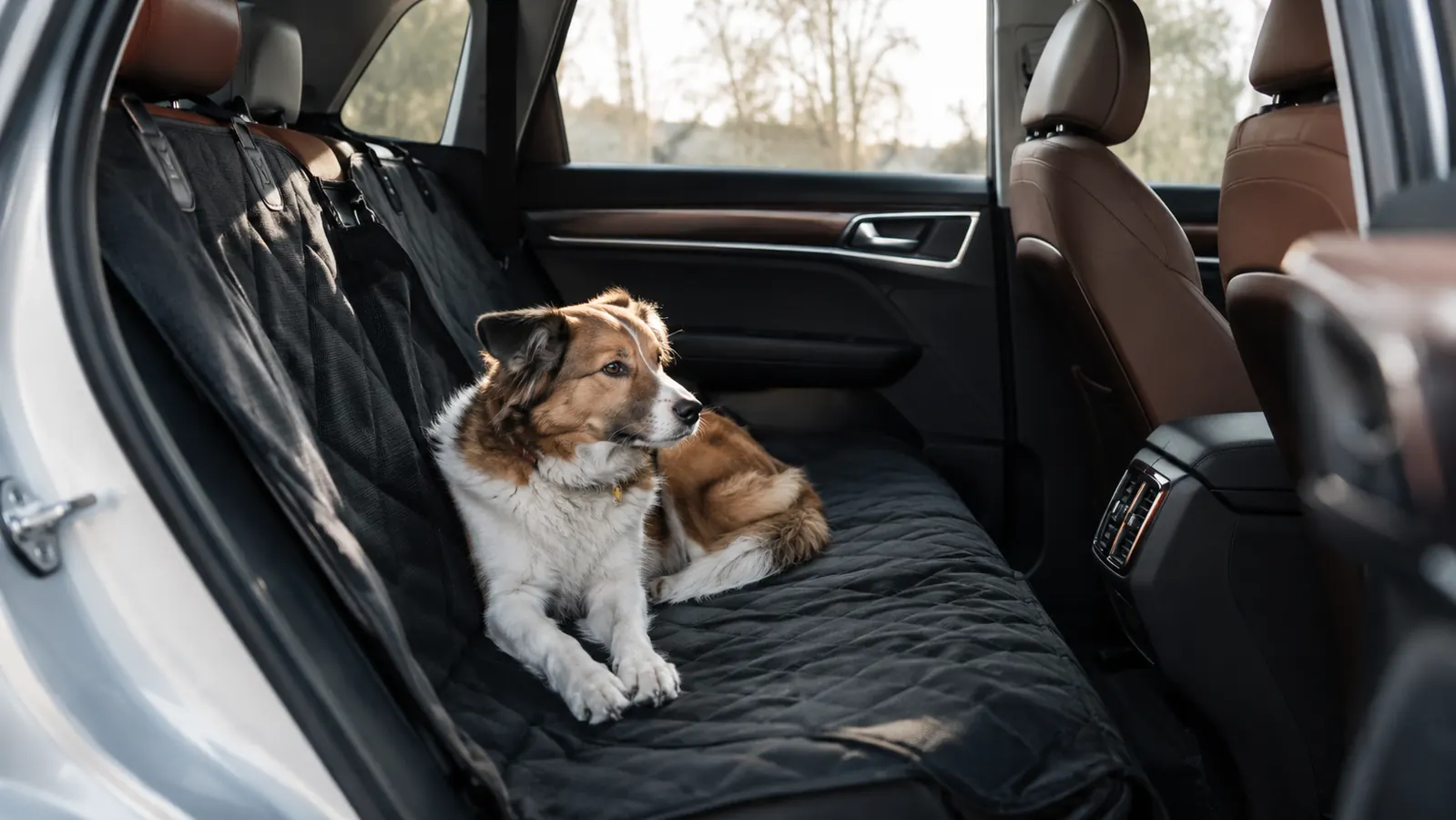
I spend more time in a truck cab than most people spend in their living room. I run I-80 between Omaha and Salt Lake, and my dog Boone rides with me in the back seat of a 2019 Ram 1500 crew cab. He is a nine-year-old yellow Lab mix, 74 pounds, with a grey muzzle and a habit of planting his front feet on the seat and clawing whenever we brake hard or a semi passes close. At first I told myself it was just wear and tear. Then I looked at the cloth seats and saw the grooves. The fabric was starting to fray where his back feet dug in, and the dirt and hair packed into the scratches were not coming out. I needed something between Boone and those seats, and I needed it to stay exactly where I put it. That is why I bought the URPOWER Dog Car Seat Cover for the back seat.
A seat cover only helps if it stays put. The moment it slides, your dog is scratching cloth again and you are no better off. So this is not a product tour. It is the installation routine I use, in the order I do it, so the cover actually does its job mile after mile. Boone has not stopped digging his feet in. Dogs do not unlearn that. What changed is that his claws now hit a waterproof hammock anchored at the headrests, clipped under the seat, and routed through the seatbelts. The seat underneath stays intact. That is the whole goal, and here is exactly how I set it up.
Stop the scratching before it reaches your seat
The URPOWER Dog Car Seat Cover sets up as a waterproof hammock across the back seat, with headrest straps and seat anchors holding it in place so a 74-pound dog can scramble without the cover moving. It is the one I run in my truck, and it is the one I would buy again.
Amazon Check Today's Price on Amazon →Step 1: Measure the back seat before you buy
You cannot stop the scratching if the cover does not cover. The biggest mistake I see at rest areas is a cover that is too small, with the dog's claws reaching exposed fabric on the edges. Measure the width of your back seat at the widest point, then measure from the top of the seat back down to the front edge of the cushion. Write both numbers down and check them against the cover's listed dimensions before you order. Take the measurement twice if you have to. An extra thirty seconds with a tape measure saves you an hour of wrestling with a cover that does not fit, and it saves your seat from the scratches that slip past the edges.
In my Ram 1500 crew cab, a lot of budget covers come up short on the sides. The URPOWER cover is cut generously, and that extra width is what keeps Boone's front feet off the door panels and the seat edges. That matters more than it sounds. A dog that plants his feet on the edge of the seat is the same dog that scratches the paint on the door sill. If your seat is on the larger side, do not assume one size fits all. A cover that is too small will slide because there is nothing for it to grab, and a sliding cover is exactly what lets nails reach the fabric.
While you are measuring, check how your headrests attach. The cover hangs on the headrest posts, so if your headrests sit flush against the seat back you need a cover with straps that thread through the gap. The URPOWER has headrest straps on both sides, and I thread them through the posts in a second. But measure first. The right size is half the fight.
Step 2: Hang the cover on the headrests first
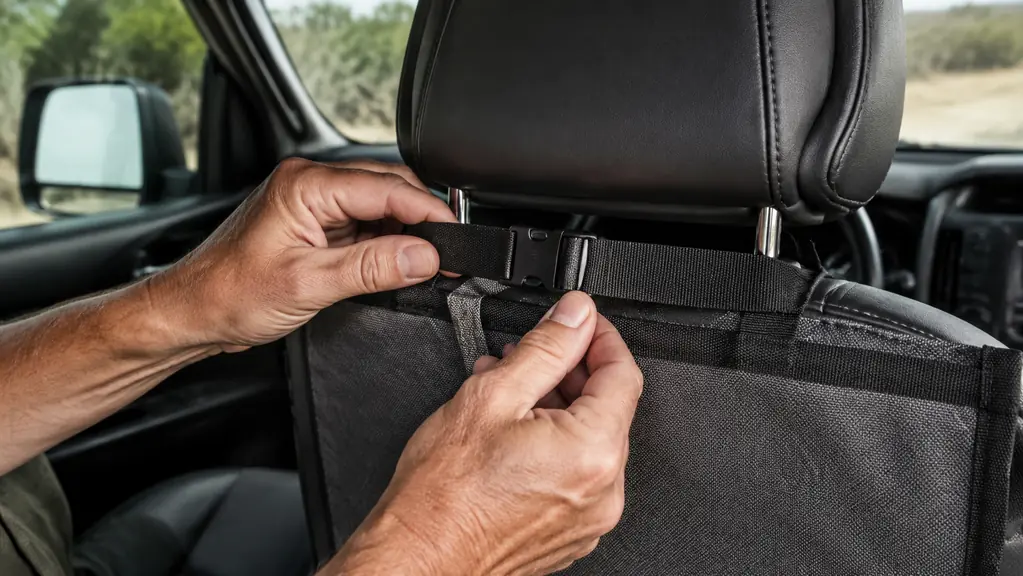
The order matters. If you lay the cover flat and then fight the straps, you will end up with a twisted, loose mess that Boone will push aside in one trip. I start at the top and work down. Take the cover out of the bag, spread it across the seat, and find the two openings at the top that go over the headrests. Slip those over the headrests so the cover hangs like a blanket before you tighten anything.
On my truck the headrest posts are exposed, so I slide the strap behind the post, bring it around, and clip it. Do both sides before you move down. This is the anchor that keeps the top of the cover from sliding forward when Boone scrambles. If the top slips, the whole cover slips, and the seat back takes the scratching. I recheck the headrest straps after every wash because they loosen up over time, and a loose top strap is the first thing that leads to a slide.
One thing I learned the hard way: pull the cover snug across the top before you clip. If there is slack, Boone's weight will push the cover into a sag in the middle, and his back feet will hit the seat where the fabric dips. A taut cover is a cover that works. Loose fabric is just an invitation for a dog to dig.
Step 3: Route the seatbelts through the slots
This is the step most people skip, and it is the step that actually stops the scratching. The URPOWER cover has openings where the seatbelt buckles come through. You want the seatbelts to stay accessible, but more importantly you want the cover to follow the contour of the seat. When you route the belts through the slots, the cover is held down across the middle, so there is no loose fabric for the dog to dig at.
I pull the seatbelt out, feed the metal end through the slot, and let it click into the buckle. Then I do the same on the other side. That does two things. It keeps the seatbelts usable, which matters when you haul people as well as dogs. And it pins the center of the cover to the seat, so when Boone shifts his weight, the cover shifts with him instead of bunching up underneath. A bunching cover is the second most common cause of scratched seats, right behind a cover that is too small.
The slots line up with the seat bottom, which is where the bottom anchors come in. The URPOWER has anchors that hook under the seat cushion, and I clip those in before I smooth the cover. That locks the bottom edge in place. Between the headrest straps up top and the anchors down below, the cover is held at four points, and a cover held at four points does not slide.
Step 4: Set the hammock straps so the middle stays high
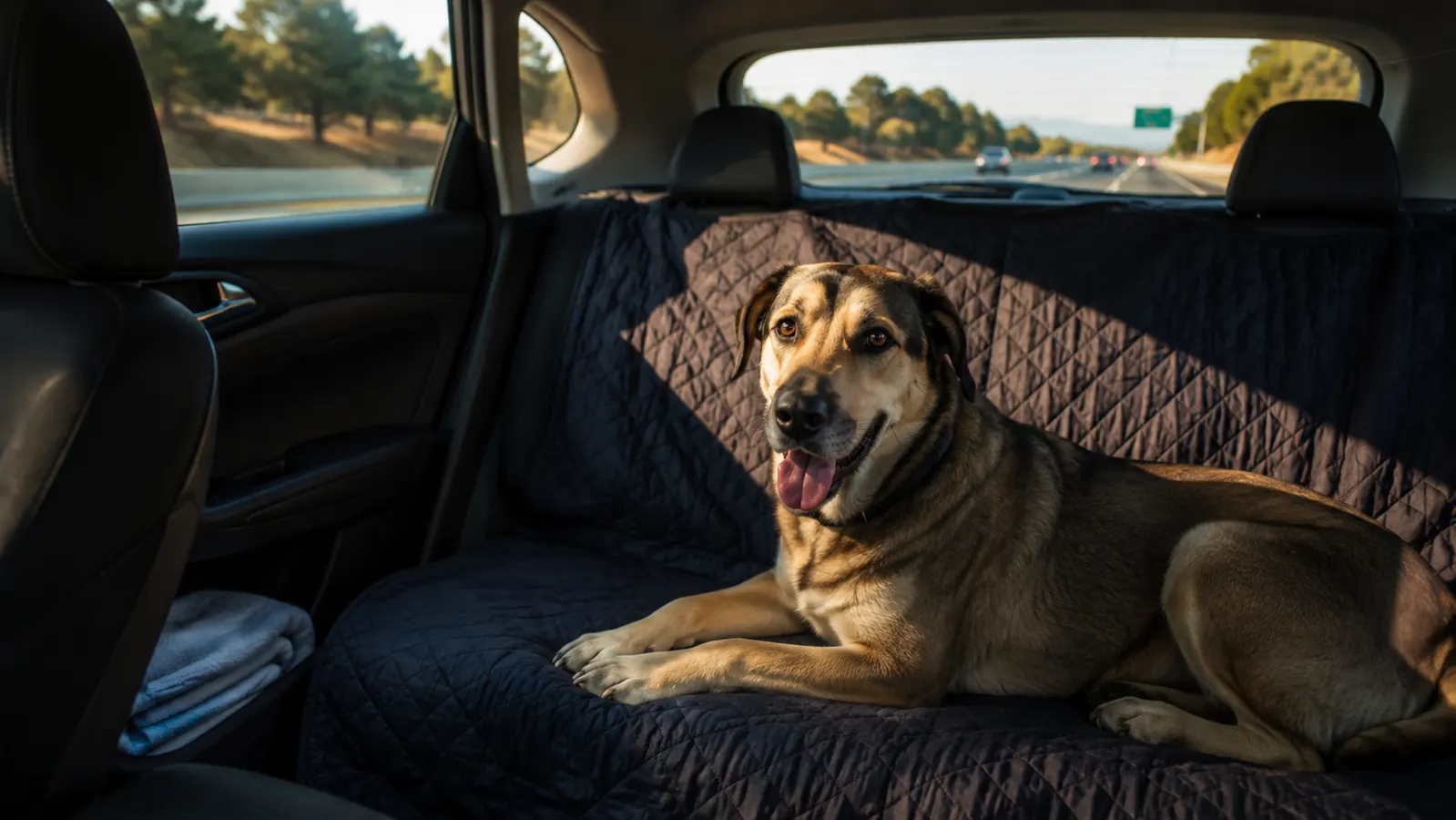
The hammock shape is what turns a seat cover into a scratch barrier. The URPOWER attaches to the front headrests with two long straps, which raises the fabric so it forms a cradle between the front seats and the back seat. When Boone stands on it, his weight spreads across the whole thing instead of concentrating in one spot. That means his claws are not driving into the seat cushion through the fabric. The cradle absorbs the scramble, and the seat takes none of it.
I run the hammock straps around the front headrests and pull them just snug enough that the fabric has a slight slope, not a tight drum and not a sag. If it is too loose, the middle droops and Boone stands in the low point, which puts his front paws against the back of the front seats. If it is too tight, the cover pulls up and leaves the seat edges exposed. About an inch of give in the middle is the sweet spot, and you will feel it when you press down on the fabric. The first time I did this I skipped the test and just pulled the straps tight. Twenty minutes later I had to pull over and reset it. Now I press the middle before I close the door.
The side benefit is that the raised sides of the hammock catch the mud and the hair and the water too. Waterproof is waterproof in every direction, so when Boone shakes after a rain, the water runs down the sides of the hammock instead of soaking into the seat. That matters on a long haul, because a wet seat is a stained seat, and a stained seat is harder to protect than a dry one.
Step 5: Trim nails, then reset the cover before every trip
No cover is a substitute for nail care. A dog with long nails will eventually find a seam or an edge, and long nails put extra pressure on every scratch. I trim Boone's nails every three weeks, and I keep a grinder in the truck for the front claws, which are the ones he uses to brace when we stop. Short nails mean the cover takes normal wear, not punishment, and the cover lasts a lot longer because of it.
Before I drive, I do a forty-second reset. I pull the cover taut side to side, re-tighten the headrest straps if they slipped, and make sure the seatbelt slots are still aligned. It sounds fussy, but it takes less than a minute and it is the difference between a cover that protects for years and a cover that wears through in months. A cover left bunched up will rub thin where it is folded, and then the claws find the weak spot. The reset costs you nothing and saves you a seat.
I also shake the cover out at the end of a long trip and wipe it down with a damp cloth. The URPOWER wipes clean fast, which keeps grit from working into the fabric and turning the surface into sandpaper. Keep the cover clean and the cover keeps the seat clean. That is the whole loop.
What Else Helps
A good cover is the foundation, but it works better when you set the dog up to succeed. I buckle Boone's harness to a short tether that clips into the same seatbelt buckle as the cover slot. That keeps him in the middle of the hammock, where he cannot reach the door panels, and it keeps him from launching forward when I brake. A harness is safer than a collar for this, and it gives him something to lean into instead of the seat. The tether keeps him in the protected zone, and the protected zone stays clean.
I also use a ramp when Boone's hips are stiff in cold weather. He can jump into the truck when he is feeling good, but on a cold morning he hesitates, and a dog that hesitates on the edge of the seat drags his nails across the cover and the seat edge. The ramp costs some room in the cab, but it protects the cover and the dog at the same time. Fewer scratches, fewer slips, and no split second of hanging half in and half out.
The cheap win is training. It took Boone about a week to learn that 'middle' means stand in the center of the hammock and wait. A dog that settles in one spot puts far less wear on the cover than a dog that paces side to side. Between the cover, the tether, the ramp and one little command, my cloth seats have stopped getting worse, and that is exactly what I wanted.
If you are still setting up, give yourself one full trip to adjust. The first time I installed the cover I tightened everything too much, and Boone spent the drive sliding on the slick surface. Loosen it a little and he found his footing. A cover needs to be snug, but it also needs to let the dog stand naturally. That balance takes one test drive to find.
Six months in, Boone has clawed at the seat on every single drive, and the cloth underneath still looks like the day I bought the truck.
Keep your seats and keep your sanity
The URPOWER Dog Car Seat Cover is the one I trust with a 74-pound dog, a long haul, and cloth seats I would rather not replace. It is waterproof, held at four points, and set up in ten minutes. If your dog is scratching up your seats, this is where I would start.
Amazon Check Today's Price on Amazon →