
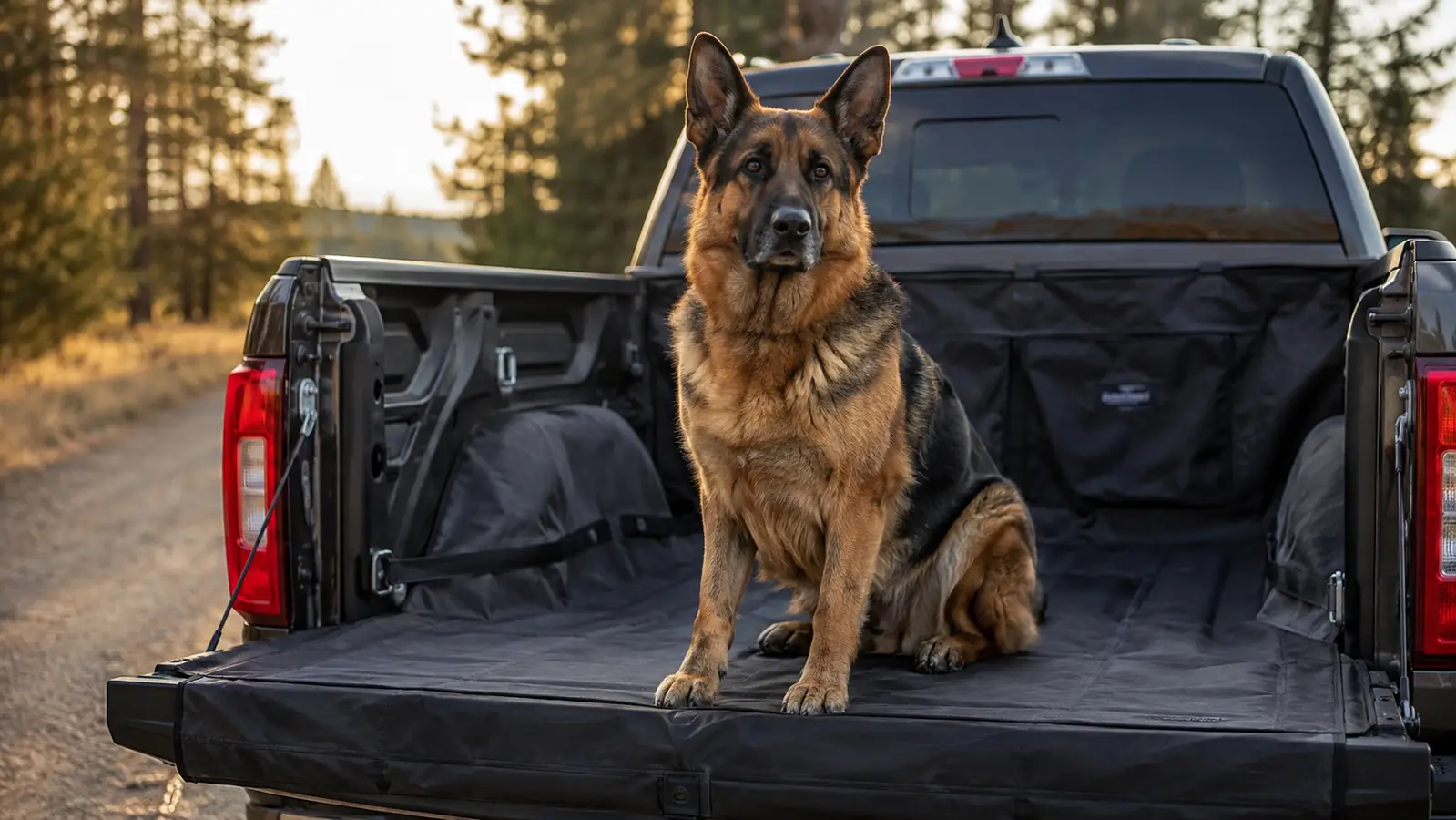
Boone has ridden in a truck cab with me since he was a pup, so I never thought much about cargo liners or seat barriers. Then I borrowed my neighbor's SUV for a week to haul a plywood project and decided to put both setups through real miles. The HelloTree SUV Trunk Cargo Liner for Dogs went in first because a liner is the obvious, low-drama answer. A tension-mesh back seat barrier was the other option. By the end of the week, I knew exactly which one belonged in which kind of rig.
Here is the short answer. The cargo liner protects the cargo area and gives your dog a nonslip place to stand. The back seat barrier keeps your dog in the cargo area and out of the front seat. They sound like the same job until you watch a 74-pound dog decide he wants to ride shotgun. The liner cannot stop that. The barrier cannot stop mud from getting on the carpet. This comparison is about knowing which problem you actually have.
How I Tested Both
The test rig was a midsize SUV with a flat cargo floor, cloth second-row seats, and a factory cargo shade. I ran the HelloTree liner for four days, then swapped it out for a tension-mesh barrier for three days. Boone rode back there every trip, including a 120-mile round trip on a rainy Tuesday and a run to the dump with a full load. I watched how he shifted on corners, how much he reacted to the harness, and what the inside of the vehicle looked like after each ride.
I also did what I always do: I talked to other owners at the truck stop and the vet's office. A Marine in a Jeep Wrangler swore by his barrier when his dog tried to climb forward. A woman with a golden retriever said she'd thrown away two seat covers before trying a cargo liner. Those conversations match what I saw. People buy one of these, and they use it for the thing the other one does. The surprise is how few people think about using both.
Head to Head
| HelloTree Cargo Liner | Back Seat Barrier | |
|---|---|---|
| What it stops | Mud, water, hair, and spills stay on the liner | The dog stays behind the mesh |
| Floor coverage | Full cargo floor plus seat-back panels and raised edges | None, it blocks a path instead |
| Keeping a climber away | Doesn't even try, a motivated dog can climb around it | That is the entire job, a solid wall stops the climb |
| Installation time | Lay it down, tuck the flaps, about two minutes | Tension rods and straps, close to twenty minutes |
| Noise on the road | It is a mat, it makes zero noise | Rods can rattle if they aren't tight |
| Mess cleanup | Pull it out and hose it off, or wipe it down | You still need a seat cover to stop the mess |
| Back seat access | Folds and rolls so the seats still work | You have to uninstall it to fold the seats |
| Cost | Usually less than a good barrier, check today's price | Wide range, quality ones run higher |
| Best for | A dog that rides in the cargo area and makes a mess | A dog that tries to get into the front seat |
Where HelloTree Wins
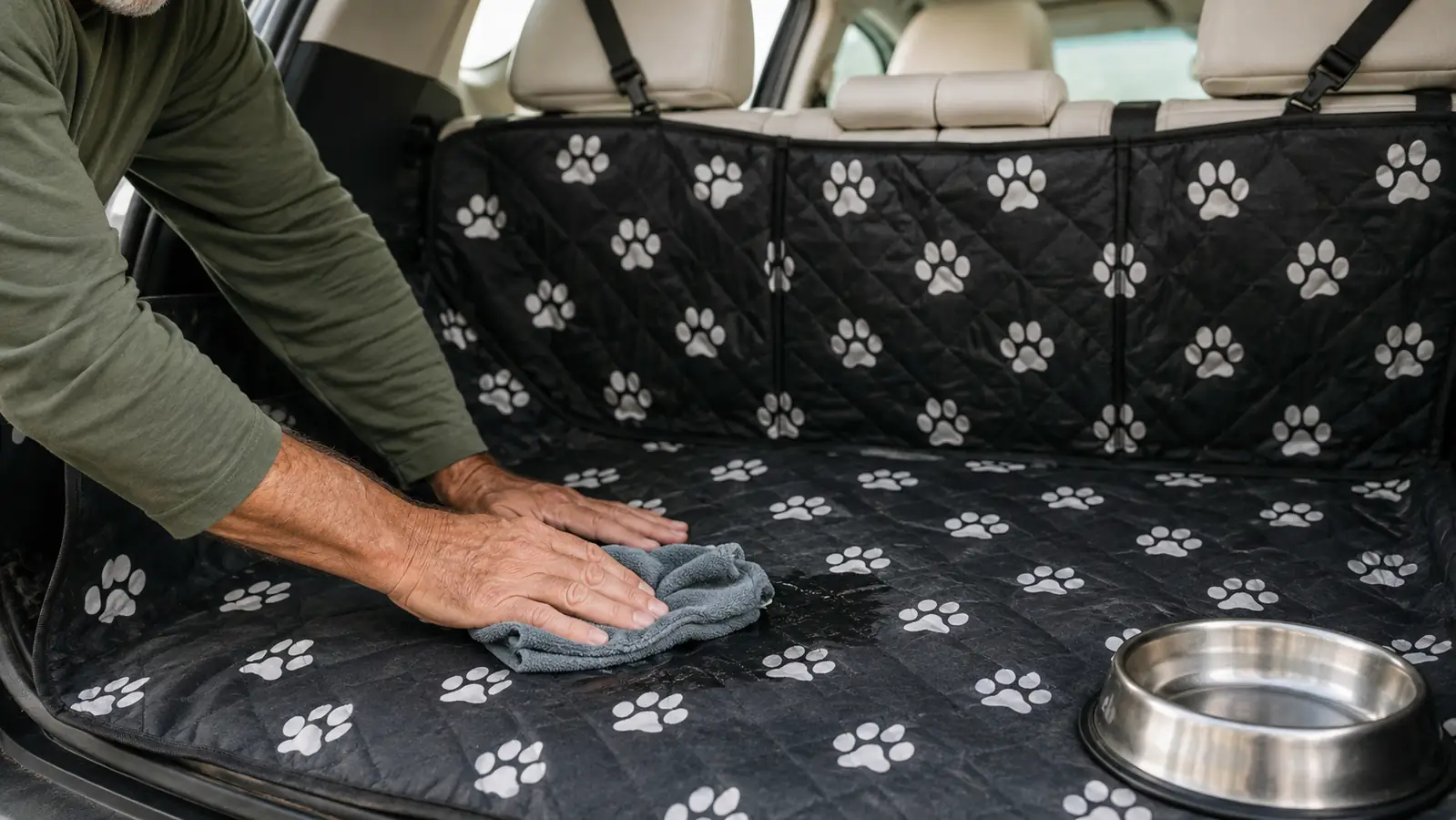
The HelloTree liner wins the mess battle by a lot. The raised edges on the cargo floor worked exactly like a tray. When Boone's travel bowl tipped on a hard stop, the water pooled on the liner instead of soaking into the carpet. He sheds constantly, and the hair gathered into a clump I could lift off instead of grinding into the fibers. On that rainy Tuesday, his feet turned the floor into a mud slick, and the liner caught all of it. The seat-back panels reached high enough that the rear of the second-row seats stayed clean too.
There is also the traction piece. The factory plastic cargo floor in this SUV was slick, and Boone had to plant his feet every time I touched the brakes. On the liner, he had grip. The padding took the edge off frost heaves and expansion joints, which matters for a nine-year-old dog with stiff hips. A liner also does not rattle. There are no rods, no clips, nothing to work loose after ten thousand miles. It is a one-piece mat that sits there and does its job.
Where a Back Seat Barrier Wins
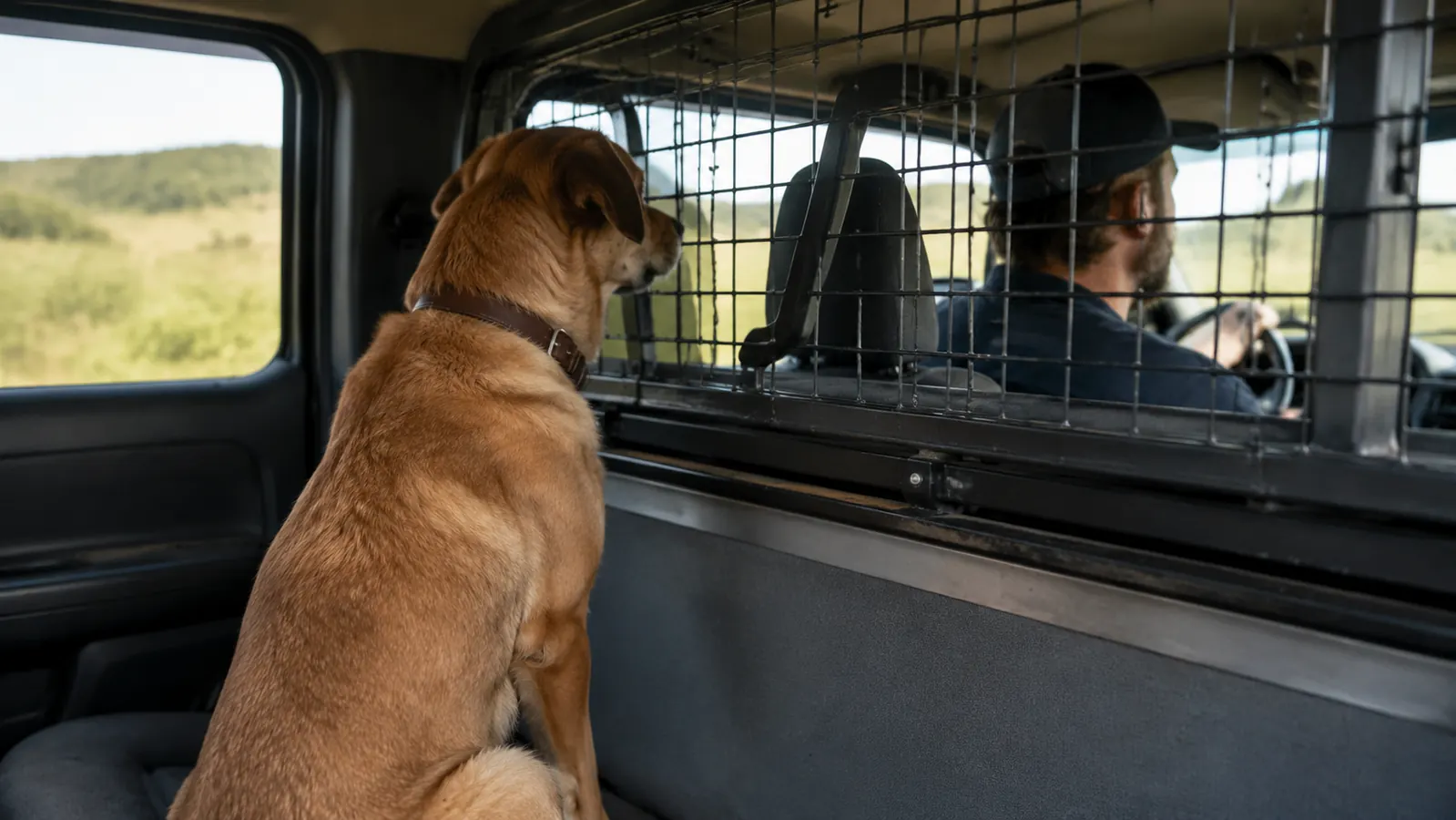
The barrier wins the containment fight, and it wins it completely. A cargo liner cannot stop a dog that has decided to climb over the folded seat. I watched my friend's German Shepherd clear the center console in one motion when the driver stepped out. A mesh barrier changes that behavior instantly because there is no path. The tension-mesh unit in my test rattled a little at first, but once I tightened the lower hooks, it went quiet. More importantly, Boone stopped trying to nose his way forward, because the mesh was a wall, not a suggestion.
The barrier also creates a clear line between the dog and the driver. That is the safety argument, and it is a legitimate one. A 74-pound dog landing in your lap at a merge is not a minor annoyance, it is a crash risk. The mesh lets you keep an eye on the dog through the rearview mirror, and it lets air and light through so the dog is not trapped in a cave. If your dog has ever shown interest in the front seat, do not try to solve that with a liner. That impulse belongs to a barrier.
If your dog rides in the cargo area, start with the HelloTree liner
It handles mud, water, and hair, gives your dog traction, and takes about two minutes to install. It won't stop a climber, so pair it with a barrier if you need that too.
Amazon Check Today's Price on Amazon →What Both Setups Miss
Neither setup does anything about the dog's hips. Boone is nine, he is 74 pounds, and he has a stiff rear end in cold weather. A liner makes standing more comfortable, but it will not help a dog that cannot jump into the cargo area in the first place. That is a ramp's job, and I mention it because owners often buy one of these, get the dog inside, then realize they cannot get him out. If your dog hesitates before jumping, solve that with a ramp before you worry about what is under his feet.
Both options also assume the dog is buckled in or at least wearing a harness. A loose dog in a cargo area can become a projectile in a crash, and a barrier is not a crash-tested restraint. The liner is even less of a safety device, it is protection for the vehicle, not the dog. So I ran both setups with Boone clipped into a harness tethered to a cargo anchor. That is the part of the system people skip, and it is the part that actually matters if things go wrong.
Installation: The Part That Decides
Installation is where the two setups split hard. The HelloTree liner took me under two minutes the first time. I opened the hatch, laid the main mat over the cargo floor, and pulled the seat-back panel up against the second row. The flaps tucked under the trim and the hook-and-loop strips held the panels in place. When I needed the seats upright, I pulled the panel down and folded the whole thing into a roll that fit behind the front seat. There is no way to install it wrong. You cannot strip a bolt, snap a clip, or get halfway and find out your vehicle needs an adapter.
The barrier was a different story. The tension-mesh unit I tested needed four rods, two lower hooks, and a top strap that looped around the headrests. The instructions said to adjust the rods until the pressure held, and I spent twenty minutes getting the angle right. The first time I hit a pothole, the whole thing shifted and I had to re-tighten it. Some barriers bolt into the vehicle, and those are more solid, but they also leave holes in the trim when you take them out. If you switch vehicles or drop the rear seats often, that friction adds up. The liner wins installation by a wide margin.
Weather Changes the Answer
Weather is the thing nobody mentions in the reviews. On a dry summer day, a barrier alone will keep your dog in the cargo area and your front seats clean. Then October comes, and your dog steps in wet gravel before hopping in. Now you have a cargo area with no liner, and the mud is in the carpet seams, not on a removable mat. I tested the barrier on a rainy Tuesday and the very next day the liner went back in. If your dog rides more than three seasons of the year, the liner is the part of the system you will use daily. The barrier is the part you will use only when the dog gets forward.
Cold weather also changes the calculus. Boone is nine and his hips get stiff below freezing. The liner's padding is not a luxury, it is insulation between his joints and a cold plastic floor. A barrier cannot add warmth. It just sits there letting the cold come up through the floor. If you run a heater under a liner and a dog bed on top, you have a workable setup. With a barrier alone, you have a cold, hard box for a dog that is already stiff. I keep a closed-cell foam pad in the truck for that exact reason, and the liner behaves the same way in the back of an SUV.
What I'd Do With My Own Truck
My Ram is a crew cab, so Boone rides in the back seat and the cargo liner never touches it. But if I ran an SUV, here is exactly what I would buy: the HelloTree liner as the base, a cheap harness with a tether, and a barrier only if the dog earned it. I would install the liner first, because it solves a problem every day. I would add the barrier after watching how the dog behaved on real drives. Boone is not a climber, so the barrier would stay in the garage. For a dog that paces or climbs, buying both is not overkill. It is the only way to get both a clean vehicle and a safe driver.
The bigger lesson is to buy for the dog you actually have, not the dog you imagine. A cargo liner does not turn a climber into a model passenger. A barrier does not turn a muddy golden retriever into a clean one. Ask yourself what has actually happened on your last ten drives. If the problem is mud on the seats, get the liner. If the problem is a dog that ends up in your lap, get the barrier. If both happen, get both. That is far less than the carpet replacement either one prevents.
Who Should Buy Which
Buy the HelloTree cargo liner if your dog rides in the cargo area and you are tired of cleaning carpet. It is also the right call if you share that cargo area with gear, because the liner rolls out of the way in seconds. Boone travels in the back seat of my Ram, so the liner stays in the garage for when I run a vehicle with an open cargo area. For a dog that sheds, drools, or digs, this is the upgrade that pays for itself.
Buy a back seat barrier if your dog has ever climbed into the front seat, or if you simply tense up every time you hit the brakes because you are not sure where the dog will be. It is the right tool for nervous dogs that pace, for dogs that get car sick and try to crawl forward, and for owners who drive alone and cannot watch the dog full time. The barrier buys you a clear, physical boundary.
For most households, the honest answer is both. Put the HelloTree liner on the cargo floor and seat backs, then add a barrier if the dog is a climber. In my test I ended the week with the liner down and the barrier stowed, because Boone is not a climber. The liner did 90 percent of the work. But if I owned a dog with a forward impulse, I would run them together and not think twice about it.
Get the HelloTree liner and stop cleaning your cargo area
This liner has saved my neighbor's SUV from a week of Boone's mud, hair, and water. Check today's price and see if it fits your vehicle.
Amazon Check Today's Price on Amazon →